


The Department of Psychology at Government College Women University, Sialkot (GCWUS) is committed to excellence in teaching, research, and community-oriented psychological practice. Its vision is to develop competent, ethical, and socially responsible psychologists equipped to understand human behavior and address emerging psychological and mental health challenges. The department follows an evidence-based, student-centered academic philosophy that integrates theoretical knowledge with practical training, research, and experiential learning. Its key strengths include qualified faculty, diverse undergraduate and postgraduate academic offerings, research engagement, clinical and applied psychology perspectives, and interdisciplinary collaboration. The department encourages critical thinking, scientific inquiry, professional ethics, and culturally relevant psychological research, particularly in areas of mental health and well-being. Through quality education, research, and community engagement, the department contributes significantly to GCWUS’s mission of empowering women through knowledge, professional competence, and meaningful social contribution.


Vision
To achieve academic excellence in the university through systematic quality assurance of HEC. 

Mission
To develop innovative and self-regulatory quality assurance system in the university for continual improvement of
academic standards. 
HOD Psychology Department
It is my privilege to welcome you to the Department of Psychology at Government College Women University, Sialkot. Psychology is a dynamic and evolving discipline that enables us to understand human behavior, mental processes, relationships, and well-being. At our department, we are committed to transforming this knowledge into meaningful education, scientific inquiry, professional competence, and positive social change. Our vision is to establish a culture of academic excellence, research innovation, ethical practice, and continuous learning. We strive to provide our students with a strong scientific foundation while developing their critical thinking, research skills, communication abilities, and practical competencies. Particular emphasis is placed on contemporary psychological challenges, mental health, human resilience, psychological well-being, and evidence-based approaches relevant to our cultural and social context. We believe that universities have a responsibility not only to produce graduates but also to develop thoughtful professionals, researchers, and future leaders. Therefore, our department encourages students to engage in research, interdisciplinary learning, community service, and professional development. As a department dedicated to women’s education and empowerment, we aim to create an inclusive and intellectually stimulating environment where every student can recognize her potential, develop confidence, and contribute meaningfully to society. I warmly invite our students, faculty, researchers, and collaborators to join us in advancing the discipline of Psychology through knowledge, innovation, compassion, and service.
Dr. Adnan Adil
Professor
adnan.adil@gcwus.edu.pk



Program/s Details
| Program Level | Program Title | Eligibility Criteria |
| BS Level (Undergraduate) |
|
Intermediate / F.Sc Pre-Eng or equivalent with min 47% marks. |
| MS / M.Phil. Level (Graduate) | MS in Clinical Psychology | 16-year education in relevant field with min CGPA 2.5/4.0 or 60%. |
| Ph.D. Level (Postgraduate) | Ph.D. in Psychology | 18-year education, MS degree with thesis, min CGPA 3.0/4.0 & GAT/GRE. |
| 01 | BS Program (/per semester) | Rs. 0.00 PKR |
| 02 | MS Program (/per semester) | Rs. 0.00 PKR |
| 03 | Ph.D. Program (/per semester) | Rs. 0.00 PKR |
STRATEGIC GROWTH STATEMENT (DEPARTMENTAL LEVEL):
The Department of Psychology, Government College Women University, Sialkot (GCWUS), envisions becoming a leading centre for psychological education, research, clinical training, and community mental health services over the next three to five years (2026–2031). Building on its existing undergraduate and graduate teaching, research-oriented curriculum, mental health awareness activities, psychological support initiatives, and faculty expertise, the department aims to strengthen academic quality, expand applied research, improve students’ professional competencies, and develop sustainable partnerships with healthcare institutions, educational organizations, industry, and national and international academic institutions. The department’s strategic growth will focus on the following priorities:
Subject to university approval, faculty availability, regulatory requirements, and demonstrated student demand, the department will explore specialized academic pathways in Clinical Psychology, Neuropsychology, Health Psychology, Child and Adolescent Psychology, Counselling Psychology, Industrial and Organizational Psychology, Forensic Psychology, and Disaster and Trauma Psychology. Short courses and professional training programmes in psychological assessment, psychological first aid, cognitive behavioural interventions, stress management, and research methods may also be developed to support continuing professional development.
The department will seek institutional support and competitive research funding to establish or strengthen facilities for experimental psychology, psychological assessment, behavioural research, and cognitive and neuropsychological studies. Proposed facilities may include a Psychological Assessment and Psychometrics Laboratory, an Experimental and Cognitive Psychology Laboratory, and a Neuropsychology and Behavioural Research Laboratory. These facilities will support practical training, supervised research, psychological scale development and adaptation, and ethically approved studies involving cognition, mental health, resilience, sleep, neurological conditions, and psychological well-being.
The department will encourage collaborative and interdisciplinary research addressing mental health challenges relevant to women, university students, families, educational institutions, healthcare settings, and local communities. Priority areas will include psychological interventions, mental health literacy, trauma and resilience, neuropsychological functioning, positive psychology, occupational well-being, and culturally appropriate psychological assessment. Faculty and students will be encouraged to publish in reputable peer-reviewed journals, present research at academic conferences, develop research proposals, and seek competitive funding through university research grants, the Higher Education Commission, and other relevant funding agencies.
A structured faculty development programme will promote advanced training in contemporary psychological assessment, evidence-based interventions, quantitative and qualitative research, psychometrics, advanced statistical analysis, research ethics, academic writing, and digital teaching. Faculty members will be encouraged to participate in national and international conferences, research collaborations, visiting-scholar programmes, and specialized professional development workshops. Curriculum review, outcome-based education, student feedback, research supervision, and continuous quality improvement will be strengthened in accordance with applicable university and Higher Education Commission policies.
The department will seek partnerships with universities, teaching hospitals, rehabilitation centres, mental health organizations, schools, non-governmental organizations, and professional psychology networks. Through GCWUS and its Office of Research, Innovation and Commercialization (ORIC), the department will explore collaborative research projects, joint seminars, faculty and student exchanges, visiting lectures, online international conferences, and co-authored publications. Partnerships with clinical and community organizations will also provide opportunities for supervised student placements and field-based research.
Building on the department’s documented mental health awareness workshops, psychological support initiatives, and collaboration with the Psychosocial Well-being Center, the department will seek to expand community-based psychological education and preventive mental health activities. Proposed initiatives include mental health literacy campaigns, psychological first-aid training, stress-management programmes, suicide-prevention awareness, student well-being assessments, and outreach services for underserved populations. All assessment and intervention activities will follow applicable ethical standards, confidentiality requirements, referral procedures, and professional supervision arrangements.
The department will work with the university’s relevant academic and quality assurance bodies to review its programmes against applicable HEC requirements, national qualification frameworks, curriculum standards, and relevant professional guidelines. It will develop a documented system for programme evaluation, faculty development, research output, internship supervision, graduate feedback, and graduate employment tracking. Any professional accreditation or recognition process will be pursued through the relevant competent authority, where applicable; NCEAC and PEC will not be treated as the default accreditation bodies for Psychology.
In collaboration with ORIC and other relevant university offices, the department will explore opportunities for student-led mental health awareness initiatives, evidence-informed psychoeducation resources, psychological research services, and socially beneficial innovations. Digital mental health literacy, telepsychology, responsible use of artificial intelligence in psychological research, data privacy, and ethical technology-assisted interventions will be incorporated into relevant teaching and research activities.
|
|
||
| Year 1 (2026–2027) | Review the curriculum and departmental needs; identify laboratory requirements; strengthen research documentation; map potential clinical, educational, and industrial partners; and establish measurable departmental development indicators. | |
| Year 2 (2027–2028) | Initiate specialized workshops and faculty training; pursue research grants; formalize selected internship and research partnerships; and develop proposals for specialized laboratories and academic pathways. | |
| Year 3 (2028–2029) | Seek approval for feasible specialization or certificate programmes; expand student research participation; strengthen supervised field experiences; and initiate collaborative research projects. | |
| Years 4–5 (2029–2031) | improve research productivity and graduate employability; pursue eligible quality recognition or accreditation processes; and revise the strategic plan in light of institutional priorities and emerging professional needs. | |
| The overall objective is to establish a sustainable, research-informed, professionally relevant, and socially responsive Department of Psychology that contributes to women's education, mental health awareness, scientific research, and the development of competent psychology graduates. | ||
FUTURE SCOPE & CAREER PROSPECTS (STUDENT LEVEL):
The Department of Psychology at GCWUS aims to prepare students for diverse opportunities in mental health services, education, healthcare support, research, human resource management, community development, and other people-centred professions. Its existing curriculum provides a foundation in psychological theory, research methodology, statistical analysis, psychological assessment, clinical and counselling psychology, health psychology, organizational psychology, forensic psychology, and internship-based learning. These areas can support further professional development and progression to relevant postgraduate qualifications.
Graduates may pursue entry-level or appropriately supervised roles in the following areas, subject to the requirements of individual employers and applicable professional regulations:
- Clinical and mental health services: Mental health programme assistant, psychological support worker, psychoeducation facilitator, or research assistant in mental health settings. Independent clinical practice and specialist clinical positions require the relevant postgraduate education, supervised training, and professional eligibility.
- Educational and school settings: Student support officer, educational programme assistant, learning-support worker, school well-being programme coordinator, or research assistant in educational psychology.
- Human resources and organizational development: HR assistant, recruitment coordinator, training and development assistant, employee well-being coordinator, or organizational research assistant.
- Research and data analysis: Research assistant, field researcher, survey coordinator, psychometric research assistant, or junior data analyst, depending on demonstrated technical skills.
- Community and development sector: Community mental health project assistant, psychosocial support programme worker, social development project coordinator, or monitoring and evaluation assistant.
- Healthcare and rehabilitation: Research or programme support roles in hospitals, rehabilitation centres, and health-related organizations, particularly in multidisciplinary mental health and well-being projects.
- Forensic and correctional settings: Research, programme support, or rehabilitation-related roles where permitted by the employer's qualification and supervision requirements.
- Entrepreneurship and digital initiatives: Mental health awareness projects, psychoeducational content development, research services, and community well-being initiatives, subject to ethical, legal, and professional requirements.
The department will aim to strengthen students’ employability through practical, competency-based learning opportunities. Priority skills include psychological interviewing, ethical assessment practices, research design, questionnaire development, data collection, statistical analysis using SPSS and other suitable tools, academic writing, report preparation, communication, teamwork, problem-solving, and professional presentation.
Students will be encouraged to participate in research projects, seminars, workshops, poster presentations, case-based learning, community awareness campaigns, and supervised field activities. Training in digital research tools, evidence-based psychoeducation, data management, and responsible use of emerging technologies will further support their readiness for evolving professional environments.
The department will seek to expand structured internship and field-placement opportunities through partnerships with hospitals, rehabilitation centres, schools, universities, human resource departments, community organizations, and mental health service providers. Placements will be linked to defined learning outcomes, appropriate supervision, confidentiality requirements, and documented performance evaluation. Students will also be encouraged to develop professional portfolios containing research projects, presentations, certificates, reflective reports, and evidence of relevant practical competencies.
Subject to institutional resources and collaboration with qualified providers, students may be offered opportunities for short courses or workshops in psychological first aid, mental health first aid, research ethics, psychological assessment, data analysis, counselling skills, stress management, safeguarding, and workplace well-being. Such training will supplement, not replace, the academic qualifications, supervised practice, or legal and professional requirements needed for regulated roles
Graduates may pursue relevant postgraduate qualifications, subject to admission criteria, in Clinical Psychology, Psychology, Counselling Psychology, Health Psychology, Educational Psychology, Organizational Psychology, Neuropsychology, Public Health, Behavioural Science, and related disciplines. Research-oriented students will be encouraged to participate in faculty-supervised projects, develop research proposals, present at conferences, publish where appropriate, and pursue MPhil/MS or doctoral-level studies in accordance with the applicable admission and qualification framework.
Through potential collaboration with GCWUS ORIC and relevant university support offices, students may be encouraged to develop socially responsible projects addressing mental health literacy, student well-being, workplace wellness, educational support, and community resilience. Proposed support may include mentoring, project development, research dissemination, innovation competitions, and guidance on ethical service design. Any independent psychological service will remain subject to applicable professional, legal, and ethical requirements.
The department will periodically review employer feedback, alumni outcomes, internship evaluations, and relevant labour-market developments to guide curriculum enhancement. Emerging areas for student preparation include digital mental health literacy, psychological well-being at work, evidence-based interventions, psychometrics, behavioural research, neuropsychological assessment support, and the responsible application of technology to psychological services and research.
The department will aim to strengthen career counselling, postgraduate admissions guidance, alumni engagement, employer interaction, and graduate tracking. Career seminars, professional networking sessions, CV-writing workshops, interview preparation, and guidance on postgraduate scholarships will help students make informed decisions about employment and further education.
Through these initiatives, the Department of Psychology seeks to develop graduates who possess a sound scientific understanding of human behaviour, strong research and communication skills, ethical awareness, practical experience, and the capacity to contribute meaningfully to mental health promotion, education, organizational effectiveness, and community well-being.
The long-term goal is to create clear pathways from undergraduate education to postgraduate specialization, supervised professional practice, research careers, and socially responsible entrepreneurship while ensuring that students’ qualifications and professional roles remain aligned with applicable standards.
Contact Details
- Address: Department of Psychology, Main Block, Aimenabad Campus, Govt. College Women University Sialkot.
- Tel: 052-9250768 | Ext. 100
- Email: adnan.adil@gcwus.edu.pk

Department Tour
Campus on a tour designed for prospective graduate and professional students. You will see how our university like, facilities, studenst and life in this university. Meet our graduate admissions representative to learn more about our graduate programs and decide what it the best for you.



News & Events
Activities
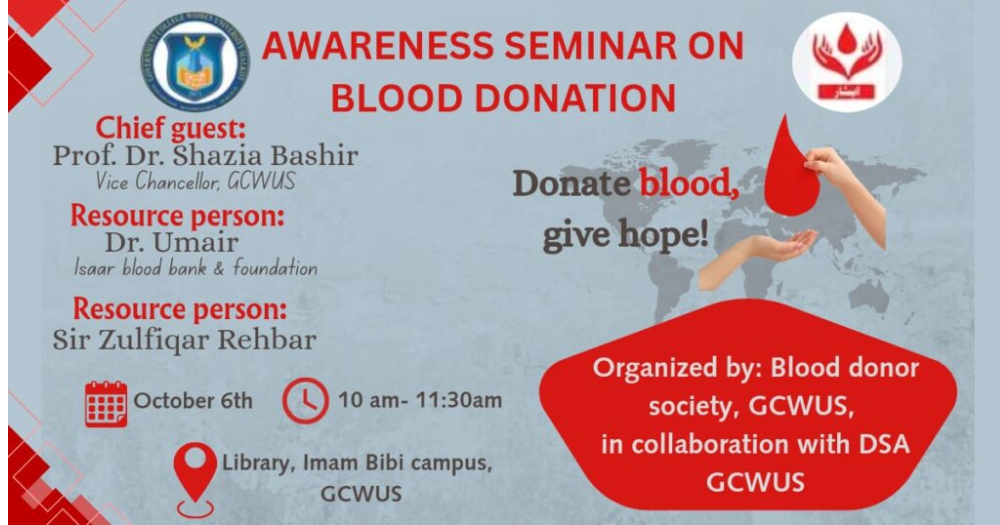
Blood Donation and Camp for Blood Sugar and Blood Group Detection
xyz.....

Making your site friendly
Seamlessly visualize quality ellectual capital without superior collaboration and idea tically

This guide is designed.
Seamlessly visualize quality ellectual capital without superior collaboration and idea tically